A wooden educational toy can turn an ordinary afternoon into hands-on learning. A child may stack blocks, match shapes, or guide a small wooden train across the floor. These simple actions invite practice with coordination, patience, and problem-solving. They also give children room to imagine their own games. But what are the benefits of wooden educational toys, and do they suit every child? The answer depends on the toy, the child’s age, and how it is used. Not every wooden toy is educational by itself.
This guide explores seven practical benefits, from sensory play and fine-motor practice to creativity, communication, and early reasoning. It also considers durability and material choices, including the value of checking labels and following age guidance. Smooth edges, sturdy construction, and pieces sized for the intended age group matter more than a natural appearance alone. A set of blocks might encourage a child to build, sort, and count, yet another child may prefer a different activity. That is worth remembering. Wooden toys can support learning, but they do not replace conversation, shared play, or a caring adult’s attention. The best choice is one a child can use safely, repeatedly, and with genuine interest.
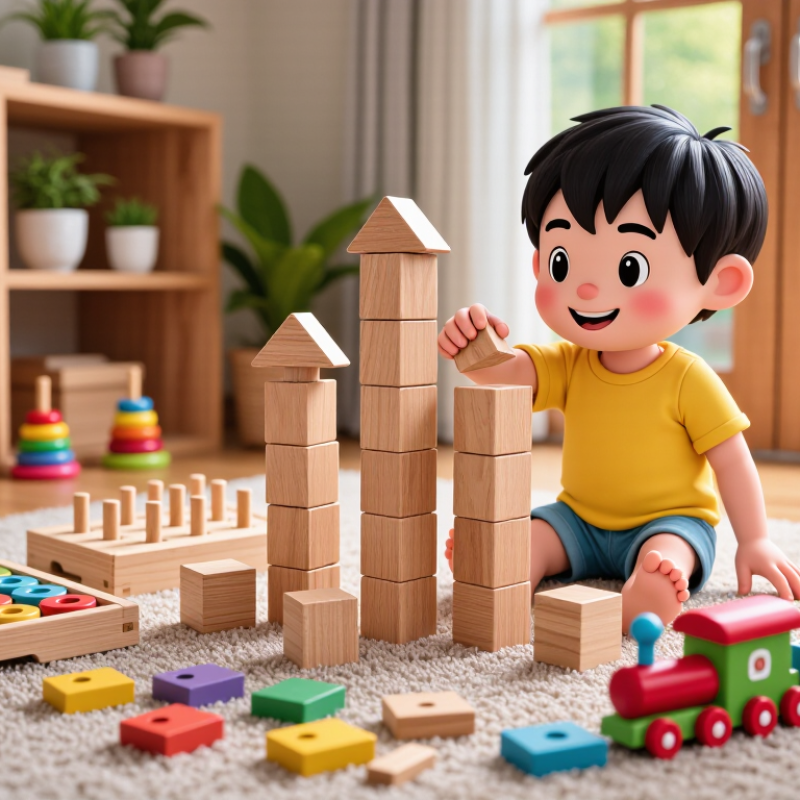
Wooden educational toys support open-ended early learning because they invite children to decide what happens next. A set of plain blocks can become a bridge, a pretend bakery, or a wobbly animal home. There is no single correct result. That freedom gives children room to test ideas, change plans, and explain their choices.
During play, a child might stack three blocks, watch them fall, then build a wider base. Small moments like this encourage spatial reasoning and persistence without turning play into a lesson. Simple shapes also prompt language: “This one is taller,” or “The bear needs a door.” No script required. Adults can extend the play with a curious question, then pause instead of taking over. That pause matters.
Wooden toys are not automatically educational, though. A toy that is too difficult, or offered without time to explore, may hold little interest. Children also vary: one may build quietly, while another invents a story aloud. Letting them lead can feel slower, and the play may look messy or go nowhere for a while. That is not always a problem. A few blocks scattered beside a half-finished tower can show a child still thinking, trying, and deciding what to do next.
Plain blocks can become a bridge, a shop, or a lopsided animal. Children choose what to build and can change their ideas. The result does not need to look perfect.
A narrow tower base may make the structure tip. Children can widen it and see what changes. Small experiments make the challenge visible.
Ask one open question, such as, “What might make it steadier?” Then wait. If frustration grows, suggest one small change instead of building the answer for them. I sometimes step in too quickly.
A study of 26 parent–infant pairs found more adult words and conversational turns with traditional toys and books than with electronic toys. It did not test wooden toys specifically. That distinction matters.
Children can pass blocks, take turns, and build together. Adults can model gentle turn-taking without directing every move. Some children may not want to share right away.
No. Check for smooth, splinter-free surfaces and securely attached parts. Coatings should meet applicable safety requirements. Wood can still break.
It addresses hazards such as sharp edges, small parts, and strength under impact or tension. In the United States, ASTM F963-23 became a mandatory toy safety standard in 2024. Standards help, but they cannot prevent every mishap.
Look for cracks, raised grain, chipped finishes, and loose pieces, especially after repeated drops. A sturdy block is not indestructible. Check it regularly.
What are the benefits of wooden educational toys? They can support early learning by inviting children to explore, experiment, and play in many different ways. Building blocks encourage fine-motor practice as children grasp, stack, and arrange pieces, while also helping them develop spatial skills such as balance, shape recognition, and an understanding of how objects fit together. Because open-ended materials do not dictate a single way to play, children can use them to invent ideas, work through challenges, and try different solutions.
Wooden toys can also create opportunities for language and social interaction. Research involving 26 parent–infant pairs highlights how shared play can encourage communication and engagement between children and caregivers. Finally, well-made wooden toys may offer durability for repeated play. Safety remains important: families should choose age-appropriate toys and check that products are designed with relevant toy-safety requirements, such as ASTM F963, in mind.

 Chicharo Toys
