Choosing wooden educational toys requires more than admiring natural grain or smooth, rounded edges. Educators examine how a toy invites thinking, movement, language, and repeated practice. The American Academy of Pediatrics’ 2018 clinical report, “The Power of Play,” links play with healthy cognitive, social, and emotional development. UNICEF and the LEGO Foundation’s Learning through Play report also describes play as active, engaging, meaningful, and socially interactive. These findings explain why are wooden educational toys recommended by educators, especially when they encourage children to build, sort, balance, or invent stories.
Maria Montessori wrote, “The hands are the chief teachers.” Her observation still matters in a classroom. A child fitting wooden blocks together feels resistance, hears a soft tap, and adjusts the structure. That small failure becomes useful feedback. NAEYC’s Developmentally Appropriate Practice guidance supports materials that match children’s abilities while allowing choice, exploration, and increasing challenge. The Toy Association’s recent trend reporting also identifies open-ended, screen-free play as a continuing priority for families and educators.
Yet wood alone proves nothing. A beautifully finished toy can still offer limited learning if it performs only one predictable action. Educators should check durability, age suitability, safety testing, repairability, and whether the toy supports several levels of play. Evidence is not always perfect. Many product claims rely on observation rather than controlled studies. That limitation deserves honesty. The strongest choice is usually simple, adaptable, and connected to real teaching goals, not merely marketed as “natural” or “educational.”
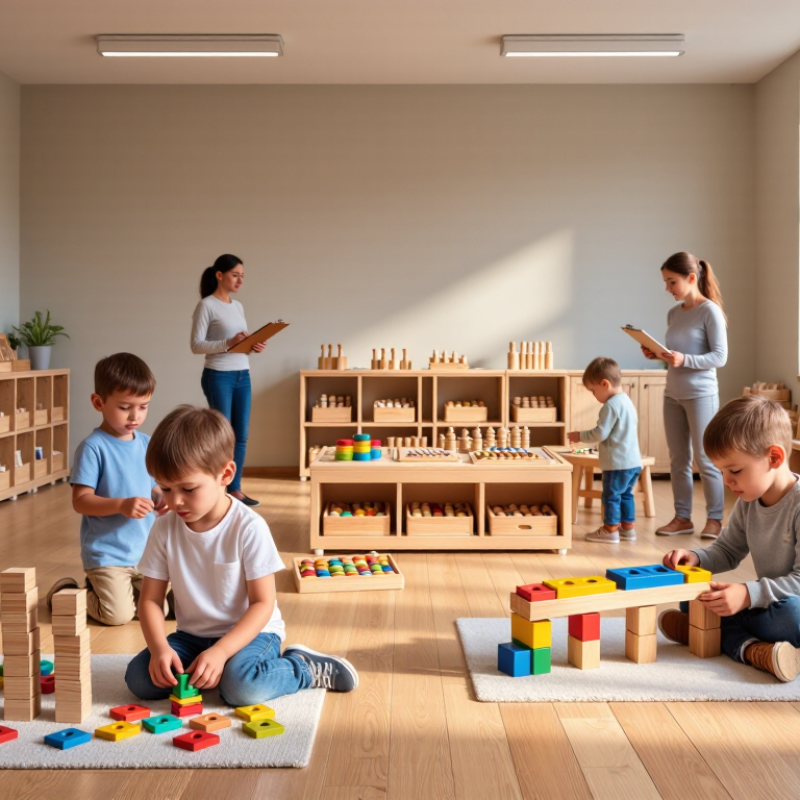
How to Choose Wooden Educational Toys Educators Trust?
Effective wooden toys make learning visible through action. Children stack, sort, count, match, and rebuild. These movements strengthen early mathematical thinking, language, and problem-solving skills.
Open-ended pieces invite more than one correct answer. That matters because children learn better when they explain choices and adjust mistakes. A 2022 systematic review in Child Development examined 39 guided-play studies. It found stronger outcomes than free play in several areas, especially early mathematics and language. An adult’s simple prompt can deepen the experience: “What could make this tower stronger?” Not every moment needs instruction.
The material alone is not educational. The American Academy of Pediatrics’ 2019 clinical report favors simple toys that encourage shared interaction over distracting electronic features. NAEYC’s developmentally appropriate practice guidance also stresses active, meaningful play. Educators should check weight, smooth edges, stable construction, and age suitability. Observe the classroom, too. Can a child grip the piece easily? Can two children use it together? Some beautiful sets are too limited. Others are durable but overly difficult. That is where judgment becomes necessary. A toy may look natural, yet still produce little learning without time, conversation, and thoughtful adult support.
| Evaluation Dimension | Why It Supports Learning | Evidence to Look For | Educator Check |
|---|---|---|---|
| Developmental Alignment | Children learn more effectively when the challenge matches their current abilities while allowing room for growth. | The toy offers manageable steps, optional challenges, and clear opportunities for independent exploration. | Can children use it successfully without constant adult assistance? |
| Fine-Motor Development | Manipulating, stacking, threading, fitting, and sorting objects exercises hand control and hand-eye coordination. | Pieces are easy to grasp, varied in shape, and suitable for actions such as pinching, placing, turning, or balancing. | Does the toy encourage purposeful hand movements rather than simple button pressing? |
| Cognitive and Problem-Solving Value | Open-ended challenges encourage children to test ideas, recognize patterns, make comparisons, and adjust strategies. | There is more than one possible arrangement, solution, or method of play. | Can children explain what they tried and why they changed their approach? |
| Early Mathematics | Sorting, sequencing, counting, comparing quantities, and exploring size or shape create concrete experiences for mathematical concepts. | The toy naturally supports classification, one-to-one correspondence, spatial relationships, or pattern-making. | Can an adult ask different questions without changing the toy? |
| Language and Social Learning | Shared play creates opportunities for describing actions, negotiating roles, taking turns, and practicing new vocabulary. | The toy can be used cooperatively and invites conversation, storytelling, or explanation. | Can two or more children participate meaningfully at the same time? |
| Safety and Material Quality | Safe construction protects children and allows educators to use the toy confidently in repeated classroom activities. | Smooth surfaces, securely attached parts, non-toxic finishes, rounded edges, and age-appropriate piece sizes. Products should have applicable safety testing documentation, such as EN 71 or ASTM F963 compliance. | Are safety instructions, material details, age guidance, and testing records available? |
| Durability and Repairability | Durable resources support repeated practice and reduce interruptions caused by breakage or missing components. | Solid construction, stable joints, resistant finishes, replaceable parts, and clear cleaning or maintenance guidance. | Will the toy remain usable after frequent classroom handling and routine cleaning? |
| Open-Ended Play | Open-ended materials encourage creativity, imagination, flexible thinking, and repeated use across different learning activities. | The toy does not depend on one fixed answer or a single scripted sequence. | Can educators adapt it for art, storytelling, mathematics, construction, or role-play? |
| Accessibility and Inclusion | Inclusive design enables more children to participate and provides multiple ways to interact with the same learning objective. | High-contrast features, tactile variation, easy-grip components, adaptable play options, and instructions that support different abilities. | Can children with different motor, sensory, language, or learning needs use it with reasonable adaptations? |
| Classroom Practicality | Resources are more likely to be used consistently when they are easy to organize, clean, explain, and connect to learning goals. | Clearly defined storage, manageable piece counts, simple setup, easy supervision, and activities that can be completed within available classroom time. | Can educators introduce, store, sanitize, and assess the toy efficiently? |
Selection principle: Prefer wooden educational toys that combine safe construction, durable materials, open-ended use, observable learning behaviors, and clear alignment with children’s developmental needs.
Children stack, sort, count, match, and rebuild pieces. These actions make mathematics, language, and problem-solving visible.
They allow several correct solutions. Children explain choices, test ideas, and revise mistakes. That process matters.
Ask simple questions, such as, “What could make this tower stronger?” Then pause. Not every moment needs instruction.
Check smooth edges, secure joints, stable construction, and suitable piece sizes. Watch for loose knobs, strings, magnets, and chipped paint.
No. Natural materials still need safe coatings, strong construction, and careful testing. “Natural” is not proof.
Look for batch numbers, material details, laboratory reports, age guidance, and applicable safety certificates. A logo alone proves little.
Wipe them with a lightly damp cloth, then dry them fully. Avoid soaking and harsh disinfectants. Never store damp toys.
Inspect pieces before each session and after delivery. Remove cracked, swollen, sharp, or loose parts immediately. Keep dated records when possible.
Children need time, conversation, and meaningful choices. A beautiful set may still offer limited learning. I sometimes trust attractive packaging too much. That is a mistake.
Choosing wooden educational toys requires more than selecting attractive products. Their learning value comes from open-ended play, which encourages children to explore, solve problems, build fine motor skills, and develop language and social abilities. To understand why are wooden educational toys recommended by educators, consider their durability, tactile appeal, and ability to support focused, screen-free learning. Reliable options should use child-safe, non-toxic materials, smooth surfaces, secure parts, and sturdy construction suitable for repeated use.
The best toy also matches the child’s age, developmental stage, and learning goals without being overly restrictive. Educators should assess whether it offers meaningful play, supports different abilities and interests, and works well for individual or classroom activities. Inclusive designs, clear age guidance, and adaptable challenges can help more children participate successfully. Finally, choose products from trustworthy manufacturers with consistent quality standards, then inspect, clean, store, and maintain them regularly to preserve safety and educational value.

 Chicharo Toys
