How Can China Top Wooden Toys Help Social Development?

Time:2026-10-19 Author:Aria
0%

How Can China Top Wooden Toys Help Social Development?

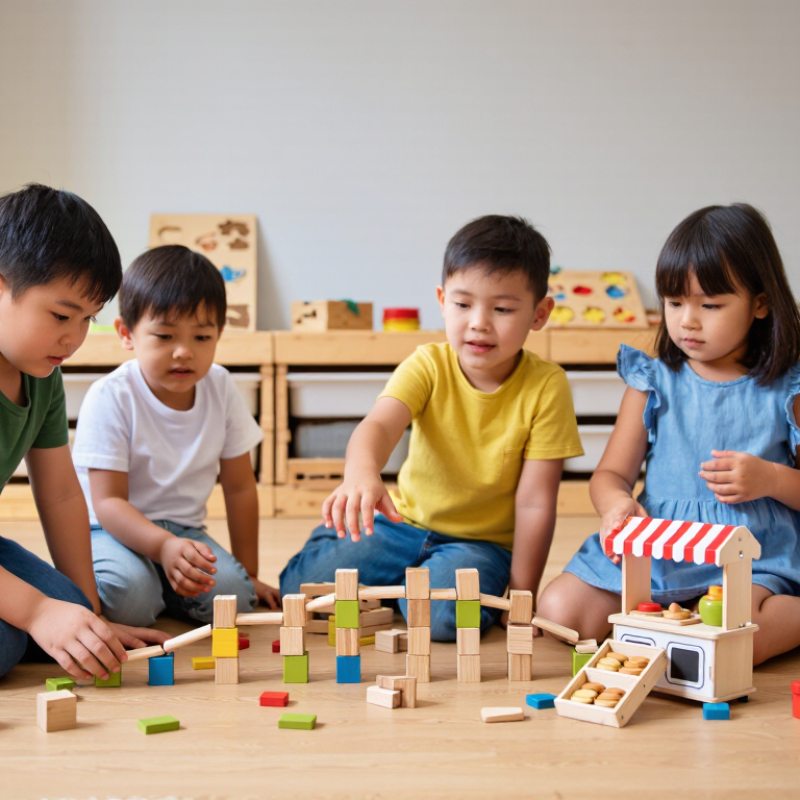
The question “how can wooden educational toys help social development” deserves more than a simple claim about natural materials. Well-designed wooden toys can create small social situations that children understand immediately. A wooden building set may invite two children to design one bridge. They must share pieces, explain ideas, and manage disagreement. A pretend kitchen can turn three quiet children into cooks, customers, and storytellers.

Peter Gray, a leading researcher on play and child development, writes, “Play is self-directed and intrinsically motivated.” This principle matters when adults choose wooden educational toys. Children learn social skills more deeply when they control the play narrative. They practice turn-taking while rolling wooden vehicles. They negotiate roles beside a miniature market. They also learn that cooperation may fail.

That failure is useful.

China’s strongest wooden toy manufacturers increasingly combine simple forms with purposeful educational design. They use puzzles, stacking blocks, role-play sets, and collaborative construction pieces. However, a wooden surface alone does not guarantee social value. Toy quality depends on age suitability, durable construction, safe finishes, clear design, and opportunities for shared play. Parents and educators should observe real use, not rely only on packaging promises.

A child may ignore an expensive set. Another may transform six blocks into a hospital. That unpredictability deserves attention. This article examines how top wooden toys from China can support communication, empathy, cooperation, and problem-solving. It also considers their limits, because social development needs responsive adults, patient peers, and meaningful everyday interaction.
How Can China Top Wooden Toys Help Social Development?

Definition and Educational Role of China’s Top Wooden Toys

China’s top wooden toys are not an official category. The phrase usually describes well-made toys produced in China, with safe materials, careful design, and useful learning purposes. They may include stacking blocks, shape sorters, puzzles, pull-along animals, and role-play sets.

Good examples have smooth edges, secure parts, suitable sizes, and clear age guidance. Reliable manufacturers should also provide material information and safety testing records. Appearance alone is not enough.

Their educational role goes beyond counting or color recognition. A child stacking six blocks practices balance, patience, and simple planning.

Two children sharing a wooden kitchen set may negotiate roles, exchange tools, and repair small disagreements. These moments support communication, empathy, cooperation, and self-control.

In classroom play, adults can ask, What could we build together? without controlling every move. Open-ended toys often leave room for different answers.

They are not magic tools. A beautifully carved puzzle can still frustrate a tired child. Some toys may also reflect limited cultural viewpoints or offer too few ways to play.

Parents and teachers should observe the child, adjust the challenge, and invite inclusive stories. I have found that quiet guidance works better than constant correction. The toy matters, but the shared interaction matters more.

How Wooden Toys Encourage Communication and Cooperative Play

Wooden toys can turn a quiet room into a small social laboratory. In classroom observations, children communicate more when one toy invites several hands. A wooden building set, for example, gives children a shared problem: how to keep the bridge standing. They point, negotiate, and explain their ideas. Sometimes, they disagree loudly. That is useful practice, not failure.

Top wooden toys from China often include stacking blocks, pretend-play pieces, puzzles, and simple construction sets. Many use open-ended shapes, allowing children to choose roles instead of following one fixed answer. One child may become the planner, while another tests balance or sorts pieces. These changing roles encourage listening, turn-taking, and cooperative decisions. Adults can support the exchange by asking, “What could we try together?” Responsible manufacturers should provide age guidance, smooth surfaces, durable joins, and finishes that meet applicable safety standards.

Still, wooden toys do not automatically create cooperation. An oversized set can cause grabbing, exclusion, or frustration. Adults may also intervene too quickly, removing the chance to negotiate. A better approach is to offer fewer pieces, model respectful language, and observe quietly. Some children need a private entry point before joining group play. That small adjustment can make shared play feel safer and more inviting.

The Impact of Wooden Toys on Empathy, Sharing, and Social Skills

Wooden toys can create small social laboratories for children. A child offers a wooden puzzle piece, waits, and watches a friend’s reaction. These simple moments practice sharing, turn-taking, negotiation, and emotional reading. The UNICEF and LEGO Foundation report Learning through Play states that play supports communication, cooperation, and problem-solving in early childhood. It also stresses that adult interaction strengthens these benefits.

China’s leading wooden toy manufacturers can support this process through open-ended designs. Blocks, stacking sets, and role-play pieces allow several children to build one scene together. One child may become the “shopkeeper”; another may invent a customer’s problem. Such play encourages empathy because children must consider another person’s wishes. The OECD Survey on Social and Emotional Skills covered nearly 70,000 students across nine countries and cities. Its findings connect stronger social-emotional skills with better peer relationships and classroom cooperation. The survey does not prove that wooden toys cause these outcomes. That distinction matters.

A calm adult can ask, “How does your friend feel now?” Children then explain, repair, and try again. Sometimes they still argue. That is normal. A toy cannot teach kindness alone. Design quality, safe materials, suitable difficulty, and patient guidance remain important. Research from the American Academy of Pediatrics also recommends hands-on, social play instead of relying only on digital entertainment. China’s wooden toy sector should measure these human outcomes, not only sales, exports, or production speed. Friends need room to disagree. That is part of learning.

How Can China Top Wooden Toys Help Social Development?

The Impact of Wooden Toys on Empathy, Sharing, and Social Skills

Open-ended wooden toys can support social development by encouraging children to communicate, take turns, solve problems together, and respond to other people’s feelings. The scores below are an evidence-informed developmental practice index, not clinical effect sizes or company-specific performance data.

Source basis: American Academy of Pediatrics, “The Power of Play” (2018); American Academy of Pediatrics, “The Importance of Play in Promoting Healthy Child Development” (2007); Yogman et al., “The Power of Play,” Pediatrics (2018). Index scale: 0–100, representing the relative opportunity for each skill during cooperative, adult-supported play.

How Cultural Design in Chinese Wooden Toys Supports Inclusion

How Can China Top Wooden Toys Help Social Development?

How Cultural Design in Chinese Wooden Toys Supports Inclusion

Chinese wooden toys can support social development when cultural design invites participation, rather than demanding prior cultural knowledge. A carved market stall, boat, or animal set gives children simple roles to share. One child becomes a shopkeeper. Another arranges the goods. Conversation grows through play.

Design details can also widen access. Large pieces are easier for small hands to grip. Clear shapes support children who process visual information differently. Tactile textures may help children explore objects without relying on complex instructions. Neutral, open-ended pieces allow mixed-age groups to play together. Teachers can introduce Chinese patterns, harvest scenes, or family traditions through short stories. The cultural context should remain accurate and respectful. Expert review matters here.

However, cultural representation is not automatically inclusive. A single symbol can become a shallow stereotype. Some children may feel excluded if every character follows one appearance or role. Designers should include varied faces, abilities, family structures, and ways of participating. Safety also requires careful checks, including smooth edges, secure parts, age guidance, and suitable finishes. These details are easy to overlook.

The best designs leave room for children to reinterpret them. A wooden mooncake may become a shop item, a building block, or a pretend drum. That flexibility supports negotiation and empathy. It also exposes a weakness: adults may explain too much. Children sometimes create richer meanings when the toy is not over-directed.

How Can China Top Wooden Toys Help Social Development? - How Cultural Design in Chinese Wooden Toys Supports Inclusion

Dimension Verified Data or Standard Social-Inclusion Meaning Implication for Chinese Wooden Toy Design
Cultural diversity China officially recognizes 56 ethnic groups. The 2020 national census recorded 125.47 million people from ethnic minority groups, representing 8.89% of the mainland population. Children can encounter cultural perspectives beyond a single majority narrative. Use respectful regional patterns, clothing references, architecture, animals, and folk stories. Explain the cultural source instead of presenting decorative motifs as generic “traditional Chinese” symbols.
Child population The 2020 census counted approximately 253.38 million children aged 0–14, equal to 17.95% of the mainland population. A large and diverse child population benefits from play materials that support different abilities, ages, and learning styles. Offer age-graded versions with clear visual instructions, large easy-grip pieces, open-ended play options, and cooperative tasks that can be adapted to different developmental levels.
Urban–rural accessibility The 2020 census recorded 901.99 million urban residents and 509.79 million rural residents, equivalent to urbanization rates of 63.89% and 36.11% rural population respectively. Inclusive play should not depend on highly specialized facilities or digitally connected environments. Prioritize durable, repairable, screen-free designs that work in homes, classrooms, libraries, community centers, and outdoor cultural-education activities.
Disability inclusion The World Health Organization estimates that approximately 1.3 billion people worldwide, or about 16% of the global population, experience a significant disability. Children with and without disabilities should be able to participate in shared play rather than being separated by product design. Combine tactile textures, high-contrast colors, large handles, audible or visual feedback, stable bases, and rules that allow several ways to complete the same activity.
Intangible cultural heritage UNESCO lists 44 elements connected with China on its Intangible Cultural Heritage lists as of 2024, including traditional craftsmanship, festivals, performing arts, and social practices. Cultural play can help children recognize heritage as living knowledge rather than as a fixed museum object. Translate processes such as carving, weaving, architecture, farming, music, or festival preparation into age-appropriate cooperative play, with contextual notes and community consultation.
Language and storytelling China is home to many spoken languages and dialects associated with its officially recognized ethnic groups; Mandarin is the national common language, but linguistic diversity remains an important part of cultural identity. Play can create opportunities for children to share family vocabulary, place-based stories, and different ways of describing the world. Use picture-based instructions, bilingual or multilingual labels where appropriate, pronunciation guides, and story cards that invite children to add local names and expressions.
Cooperative social play The United Nations Convention on the Rights of the Child, Article 31, recognizes children’s right to rest, leisure, play, recreation, and participation in cultural and artistic life. Play is a recognized part of children’s social, cultural, and emotional development. Design shared building, sorting, role-play, and storytelling activities with collective goals instead of relying only on winner-takes-all competition.
Toy safety China’s national toy-safety framework includes GB 6675.1-2014, “Safety of Toys—Part 1: Basic Specifications,” covering basic safety requirements such as mechanical, physical, flammability, and chemical considerations. Safe products allow children with different levels of supervision and physical ability to participate more confidently. Use smooth surfaces, secure components, non-toxic finishes, rounded edges, clear age guidance, and warnings about small parts. Safety information should be easy for caregivers to understand.
Environmental responsibility Wood is a renewable material when sourced from responsibly managed forests; however, wood products are not automatically sustainable without traceable sourcing and responsible manufacturing. Long-lasting products can reduce replacement needs and support more equitable access to play resources. Favor repairable construction, replaceable parts, minimal packaging, water-based finishes, and documented legal or responsibly managed timber sources.
Community participation UNESCO’s Convention for the Safeguarding of the Intangible Cultural Heritage emphasizes the participation of communities, groups, and relevant individuals in safeguarding their cultural heritage. Cultural representation becomes more respectful when local knowledge holders help shape the design and interpretation. Involve educators, parents, craftspeople, children, and community representatives in research, prototype testing, translation, and review of cultural content.
Data sources: National Bureau of Statistics of China, Seventh National Population Census of 2020; UNESCO Intangible Cultural Heritage; World Health Organization, Global Report on Health Equity for Persons with Disabilities; United Nations Convention on the Rights of the Child, Article 31; Chinese national standard GB 6675.1-2014, Safety of Toys—Part 1: Basic Specifications.

Choosing Wooden Toys for Different Ages and Social Learning Needs

How Can China Top Wooden Toys Help Social Development?

Choosing wooden toys by age can support practical social learning. For toddlers aged one to two, stacking blocks and simple pull-along toys encourage turn-taking with an adult. Children can point, imitate, and request help. The American Academy of Pediatrics’ 2018 clinical report connects play with language, self-regulation, and social development. However, wood is not magic. A silent block may invite conversation, but it cannot create interaction alone.

From ages three to four, pretend kitchens, animal figures, and matching games support sharing and role negotiation. Children learn to say, “Your turn,” or repair a small disagreement. For ages five to six, cooperative building sets and rule-based games develop patience, planning, and flexible thinking. OECD’s Starting Strong research emphasizes peer interaction and guided play in quality early learning. UNICEF data also shows that millions of young children lack regular stimulating interaction at home, making shared play especially valuable. The exact effect varies. Some children prefer watching before joining.

Tips: Choose open-ended toys with several possible uses. Offer two or three pieces first, then add more. Sit nearby, but avoid controlling every move. Ask, “What can we build together?” instead of giving instructions. Check age labels, smooth surfaces, secure parts, and tested finishes. Observe the child’s response for one week. If the toy causes repeated frustration, change the activity, not the child.

FAQS

How can wooden toys support empathy in children?

Children practice noticing feelings during shared play. One child offers a puzzle piece and watches a friend’s reaction. They may discuss, repair, and try again. Not every moment works. Arguments still happen.

Can wooden toys improve sharing and turn-taking?

Yes, open-ended toys can create natural turns. Children may pass blocks, wait, and negotiate roles. An adult can ask, “Whose turn is next?” Short reminders often help.

Which wooden toys encourage cooperative play?

Blocks, stacking sets, role-play pieces, and simple rule-based games work well. Several children can build one market, boat, or animal scene. Shared goals encourage conversation. Keep extra pieces nearby.

How should adults guide social play?

Sit close and observe before stepping in. Ask, “How does your friend feel now?” Avoid controlling every move. Children sometimes invent better meanings alone.

Which toys suit toddlers aged one to two?

Large stacking blocks and simple pull-along toys are useful. They support pointing, imitation, requesting help, and adult turn-taking. Choose pieces that are easy to grip. Keep supervision close.

What toys suit children aged three to six?

Children aged three to four may enjoy pretend kitchens, animals, and matching games. Ages five to six may enjoy cooperative building sets and rule-based games. Preferences vary. Some children watch first.

How can cultural wooden toys support inclusion?

Market stalls, boats, animals, harvest scenes, and family settings can invite shared roles. Include varied faces, abilities, families, and participation styles. Cultural details should remain accurate and respectful.

What safety features should families check?

Check smooth edges, secure parts, suitable finishes, and clear age guidance. Large pieces reduce gripping difficulty. Inspect the toy regularly. Small loose parts need special attention.

What should adults do when a toy causes frustration?

Offer only two or three pieces first. Add more gradually. Change the activity, not the child. A difficult toy may need simpler play. That is worth reflecting on.

Conclusion

China’s top wooden toys combine simple, durable design with meaningful educational value. Through puzzles, building sets, role-play figures, and sorting games, children can explore problem-solving while learning how to communicate their ideas. Shared play encourages them to take turns, negotiate rules, cooperate toward a goal, and resolve small disagreements peacefully. This explains how can wooden educational toys help social development: they create practical opportunities for children to listen, express feelings, understand different viewpoints, and practice patience.

The open-ended nature of wooden toys also supports empathy, sharing, and creativity. Children can invent stories and roles that include different families, communities, and cultural experiences, helping them appreciate diversity and feel included. When choosing toys, adults should consider age, safety, skill level, and social learning needs. Younger children may benefit from simple matching or cooperative activities, while older children can use construction sets, pretend-play scenes, and group challenges to develop leadership, teamwork, and respectful communication.

Aria

Aria

Aria is a dedicated marketing professional with a deep passion for innovative strategies and a keen understanding of our company's product offerings. With a wealth of experience in the industry, Aria excels at crafting engaging content that highlights the unique features and benefits of our......