Sensory development shapes how children notice, interpret, and respond to the world. A child’s fingers feel the ridges of a wooden puzzle piece. Their eyes track its colour and shape. Their hands learn pressure, balance, and direction through repeated movement. These small experiences build foundations for coordination, attention, and early problem-solving.
So, how do wooden toys enhance sensory development? The American Academy of Pediatrics explains in its 2018 clinical report, The Power of Play, that play supports language, executive function, and social-emotional growth. The World Health Organization’s 2019 guidelines also connect active, varied movement with healthy development in young children. Industry research adds useful context. Circana’s 2024 global toy market reporting identifies construction, activity, and preschool categories as important areas of continued consumer demand. However, market popularity does not prove developmental value. That distinction matters.
Dr. Carla Hannaford, a developmental educator and author, wrote, “The hands are the brain’s primary teachers.” Her statement helps explain why open-ended wooden toys can be meaningful. Stacking rings, textured blocks, and simple pull toys invite children to touch, move, compare, and try again. They often provide stronger tactile feedback than lightweight plastic objects. Sometimes, less is more.
Still, wooden toys are not automatically superior. Their value depends on design, safety, age suitability, and adult interaction. A beautiful toy may remain untouched. A plain wooden block may become a bridge, a drum, or a pretend meal. This guide examines the evidence, practical experiences, and limitations behind sensory-rich wooden play.
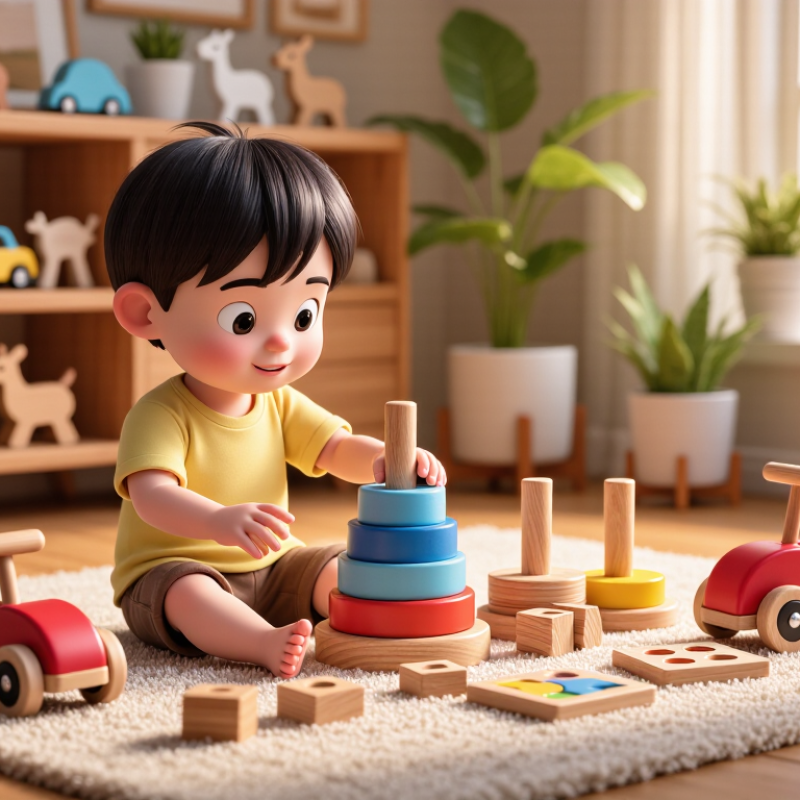
Sensory development means how young children notice, organize, and respond to information from their bodies and surroundings. Sight, sound, touch, movement, taste, and smell all shape early learning. A baby may stare at a bright object, while a toddler may squeeze clay or tap a cup repeatedly. These actions are not random. They help children understand texture, weight, distance, rhythm, and cause and effect.
Wooden toys can offer clear, manageable sensory experiences. A smooth block feels different from a ridged ring. A wooden puzzle makes a quiet click when its piece fits. Pulling, stacking, sorting, and rolling also develop hand control and spatial awareness. Open-ended toys invite children to test ideas without one correct script. That matters. Play should remain active and child-led.
It is tempting to say wooden toys are always better, but that claim needs caution. Material alone does not create healthy development. A safe, age-appropriate toy, patient interaction, and enough free play matter more. Caregivers can watch closely: Does the child avoid a texture, seek strong movement, or become overwhelmed by noise? These observations can guide gentle choices. A child may ignore an expensive-looking toy and prefer two plain blocks. That is normal. Sensory development is uneven, personal, and influenced by sleep, temperament, relationships, and daily experience.
Sensory development is how children understand themselves and the world through their five senses. Every grasp, glance, sniff, and sound provides information. Touch may begin with a smooth wooden ring held in a small hand. Children feel weight, temperature, edges, and texture. These simple differences encourage careful movement and attention.
Sight notices color, shape, size, and movement. A wooden puzzle invites children to compare pieces and recognize patterns. Hearing responds to tapping, rolling, or the soft knock of blocks.
Smell can arise from clean wood, though strong artificial scents may distract or irritate. Taste is more complicated. Babies often explore by mouthing objects, so caregivers should choose suitable toys and supervise closely. Never assume natural materials are automatically safe.
The best learning often happens during shared play. An adult might say, “That block feels rough,” or pause before offering another piece. Such language connects sensation with meaning. A child may ignore a toy today and explore it tomorrow. That is normal.
I used to think more features meant more learning, but quiet, open-ended objects can invite deeper discovery. Child-development guidance also stresses age suitability, secure construction, and regular inspection for splinters or loose parts. A wooden toy supports development, but it cannot replace conversation, movement, or responsive care.
Sensory development is how children interpret touch, sight, movement, and sound. Wooden toys can support this process through simple, physical interaction. A smooth block feels different from a ridged ring. A red triangle looks different from a natural wood cylinder. These contrasts help children notice texture, shape, weight, and color while their hands and eyes work together.
The World Health Organization’s 2019 guidelines recommend avoiding sedentary screen time for infants and limiting it for young children. Open-ended wooden toys offer a hands-on alternative. Children can grasp, stack, rotate, and compare objects at their own pace. A toddler may rub a cool wooden surface, then tap it against another piece. That small action provides tactile feedback and visual information about size, distance, and movement. The experience is concrete, not merely observed.
Still, wooden toys are not automatically beneficial. A poorly designed toy may be too heavy, visually confusing, or difficult to hold. The American Academy of Pediatrics emphasizes age-appropriate, supervised play, especially with small parts. Research on early childhood development, including findings summarized by WHO, UNICEF, and the World Bank, links responsive play with stronger early learning opportunities. However, toy quality alone cannot create development. Adult interaction matters. Ask a child what feels rough, what rolls, or which piece fits. Sometimes the best learning moment is a failed tower.
Wooden toys support motor and cognitive development through simple, repeated actions. A child grips a thick block, turns it, stacks it, and watches it fall. These movements strengthen hand control, bilateral coordination, and early spatial awareness. The American Academy of Pediatrics explains that play helps develop executive function, language, and social-emotional skills. Open-ended wooden toys can encourage these abilities because children decide how to use them. There is no single correct result.
Movement matters, too. The World Health Organization’s 2019 guidelines recommend at least 180 minutes of daily physical activity for children aged one to four. For ages three and four, at least 60 minutes should involve moderate-to-vigorous activity. Wooden climbing pieces, push toys, and balance boards can support active exploration when adults supervise closely. Still, the evidence is less tidy than advertisements suggest. A wooden toy is not automatically educational. Design, age suitability, and adult interaction influence its value.
A sorting tray may introduce color and quantity. A puzzle may invite persistence after failure. Short conversations make the experience richer: “Why did the tower lean?” The CDC’s developmental milestone guidance stresses observing what children can do and discussing concerns with professionals when progress seems unusual. Caregivers should also check for small detachable parts, splinters, and unstable surfaces. Simple toys can create complex learning. Sometimes, they only create noise.
| Approximate Age | Developmental Dimension | Relevant Sensory Experience | Wooden Toy Activity | Observable Motor or Cognitive Skill | How the Toy May Support Learning |
|---|---|---|---|---|---|
| 0–6 months | Visual and tactile exploration | High-contrast shapes, varied textures, light weight, and gentle movement provide visual and touch-based information. | Supervised grasping of a smooth, lightweight wooden rattle or textured teether designed for infants. | Briefly focusing on an object, reaching, grasping, bringing objects toward the mouth, and beginning hand-to-hand transfer. | Repeated reaching and grasping connect visual attention with hand movement. Simple shapes help keep the sensory input clear and manageable. |
| 6–12 months | Cause and effect | Sound, movement, weight, and object permanence become meaningful through repeated actions. | Shaking a wooden rattle, rolling a wooden ball, or placing large wooden objects into and out of a container. | Improved grasp control, transferring objects between hands, searching for a partly hidden object, and intentionally repeating actions. | The child can see and feel the immediate result of an action, supporting early problem-solving and memory for simple events. |
| 12–24 months | Gross motor coordination and spatial awareness | Whole-body movement, balance, depth, direction, and object position are explored through active play. | Pushing a sturdy wooden vehicle, carrying large wooden blocks, or placing large pieces into a simple inset puzzle. | Walking while carrying an object, squatting and standing, releasing objects deliberately, and matching a piece to an opening. | Push-and-pull play encourages coordinated movement, while fitting and placing activities introduce shape, position, and trial-and-error reasoning. |
| 2–3 years | Fine motor control and construction | Size, balance, pressure, resistance, and orientation can be compared through hands-on manipulation. | Stacking wooden blocks, turning large wooden knobs, completing simple puzzles, or threading large wooden beads with supervision. | Building a short tower, using both hands together, rotating pieces, improving release accuracy, and beginning to plan a sequence of actions. | Open-ended construction allows children to adjust force and placement. Errors provide immediate feedback without requiring a single correct answer. |
| 3–4 years | Planning and symbolic thinking | Children integrate visual, tactile, and proprioceptive feedback while organizing objects and representing familiar experiences. | Building a bridge or enclosure with blocks, using a wooden shape sorter, or engaging in pretend play with simple wooden figures. | Following a basic plan, balancing pieces, recognizing shapes, using objects symbolically, and explaining a simple construction or story. | Wooden pieces with few fixed functions encourage flexible use, language development, imagination, and early executive-function skills such as planning. |
| 4–5 years | Problem-solving and fine motor precision | Children refine hand strength, visual discrimination, sequencing, and control of small movements. | Completing more complex wooden puzzles, arranging pattern blocks, using a lacing board, or constructing a stable model. | Recognizing patterns, rotating pieces mentally, coordinating both hands, persisting through difficulty, and correcting mistakes independently. | Manipulable pieces make spatial relationships visible and tangible. Gradually harder challenges can support persistence and cognitive flexibility. |
| 5–6 years | Early logical reasoning and self-regulation | Children compare attributes such as length, shape, balance, quantity, and order while managing attention and frustration. | Sorting wooden objects by one or more attributes, completing tangram-style designs, or following a construction challenge. | Classifying, sequencing, estimating, testing a hypothesis, explaining a strategy, and delaying an impulsive response. | Hands-on materials turn abstract relationships into visible actions and support discussion, reflection, and step-by-step reasoning. |
| All ages | Social-emotional and language development | Shared attention, turn-taking, communication, and emotional responses occur during cooperative play. | Building together, taking turns with a puzzle, creating a pretend-play scene, or describing a completed structure. | Requesting help, negotiating roles, describing actions, listening to another person, and recovering from an unsuccessful attempt. | Low-tech, open-ended play creates opportunities for adult-child conversation and peer cooperation. The developmental benefit depends on interaction, not on wood alone. |
| Important interpretation | Wooden toys are not automatically superior to toys made from other materials. Their potential value commonly comes from features such as durability, tactile variety, simple mechanisms, visible cause and effect, and opportunities for open-ended play. Development varies among children, so activities should be matched to individual abilities and supervised appropriately. | ||||
| Safety considerations | Choose age-appropriate toys with secure parts, smooth surfaces, non-toxic finishes, and no accessible small components for children who still mouth objects. Inspect toys regularly for cracks, splinters, loose parts, or peeling finishes, and follow the applicable local toy-safety requirements. | ||||
Age ranges are approximate examples of commonly observed developmental progressions, not diagnostic milestones. Children develop at different rates, and supervised, responsive adult interaction is an important part of sensory, motor, language, and cognitive learning.
Sensory development involves how children notice, interpret, and respond to touch, sound, movement, sight, and weight. Choosing wooden toys should begin with the child’s learning needs, not appearance. A 2016 Lancet series estimated that 250 million children under five risked developmental delays because of poverty and limited stimulation. Responsive play can help create richer daily experiences.
For tactile learning, choose smooth blocks, nesting pieces, or textured puzzles. Their weight gives hands clear feedback. For visual learning, use simple shapes and contrasting colors. Avoid overly busy designs. Children seeking movement may benefit from pull toys, stacking games, or balance-based play with adult supervision. Wooden toys usually produce less electronic noise, allowing children to notice their own actions. The American Academy of Pediatrics links play with language, self-regulation, and executive-function development. Still, wood itself is not automatically educational. The interaction matters more.
Tips: Watch how the child plays for five minutes. Does the child squeeze, shake, avoid, or repeat? Offer one new texture at a time. Check for splinters, loose parts, and age suitability. The World Health Organization recommends abundant active play and limited sedentary screen time for young children, so rotate toys with floor movement. I have found that quieter toys often invite longer concentration, though this is not universal. Some children need sound, mess, and movement before calm attention appears. Reconsider the toy when interest fades.
Children can feel smooth, ridged, cool, or rough surfaces. These differences help them notice texture, weight, and shape.
Simple shapes and contrasting colors help children compare size, distance, and form. A red triangle looks unlike a natural wood cylinder.
They offer hands-on play without electronic displays. Children can grasp, stack, rotate, and compare pieces at their own pace.
Smooth blocks, textured puzzles, and nesting pieces provide clear feedback. Offer one new texture at a time.
Pull toys, stacking games, and supervised balance activities can encourage movement. Keep the floor clear.
No. Design and interaction matter more than the material. A heavy or confusing toy may frustrate a child.
Ask simple questions, such as, “What feels rough?” or “Which piece fits?” Stay responsive, but avoid controlling every action.
Check for splinters, loose parts, sharp edges, and suitable size. Supervise play closely when small pieces are present.
Watch the child play for five minutes. Notice whether they squeeze, shake, avoid, repeat, or lose interest.
Let the failed tower become part of learning. A small collapse can teach balance, weight, and persistence. Sometimes the toy still needs reconsideration.
Sensory development in early childhood is the process through which children understand and respond to the world using sight, touch, hearing, smell, and taste. Through hands-on exploration, they gradually build body awareness, coordination, attention, and problem-solving abilities. Wooden toys can support this process by offering natural textures, varied shapes, gentle sounds, and simple visual details that encourage children to observe, handle, compare, and experiment.
How do wooden toys enhance sensory development? Their solid surfaces and distinct forms stimulate tactile and visual skills while inviting children to grasp, stack, sort, fit, and move objects. These activities strengthen fine motor control, hand-eye coordination, spatial awareness, and early cognitive thinking. The best toys should match a child’s age and sensory needs, such as textured pieces for touch exploration, puzzles for visual reasoning, or building sets for motor planning. Through open-ended play, wooden toys allow children to learn at their own pace while developing confidence and creativity.

Chicharo Toys