What makes wooden educational toys sustainable is more complex than choosing wood over plastic. A wooden puzzle may feel natural, yet its full footprint includes forestry, adhesives, coatings, transport, and disposal. The material alone does not guarantee responsible production.
The Forest Stewardship Council reports that certified forests must meet environmental, social, and economic standards. Its chain-of-custody system can also trace wood from forest to finished product. This matters when manufacturers in China source beech, rubberwood, or bamboo for classroom toys. The Circularity Gap Report 2024 found that only 7.2% of the global economy was circular. That figure exposes a serious weakness. Durable design remains uncommon.
William McDonough, a leading circular-design expert, offers a useful principle: “Waste equals food.” For educational toys, this means designing wooden blocks, counting boards, and shape sorters for long use, repair, reuse, and safer material recovery. Rounded edges, water-based finishes, replaceable parts, and plastic-free packaging can reduce unnecessary waste. They also make daily handling safer for small children.
But the picture is not perfect. Rubberwood can be a valuable by-product, yet distant shipping may increase emissions. A toy may last ten years, but only if children actually enjoy using it. The UN Environment Programme has emphasized life-cycle thinking in sustainable consumption. Therefore, our China Top 10 review will examine evidence, not appearance. We will compare wood sources, finish chemistry, durability, repairability, packaging, and supplier transparency. The central question remains: what makes wooden educational toys sustainable in real homes and classrooms?
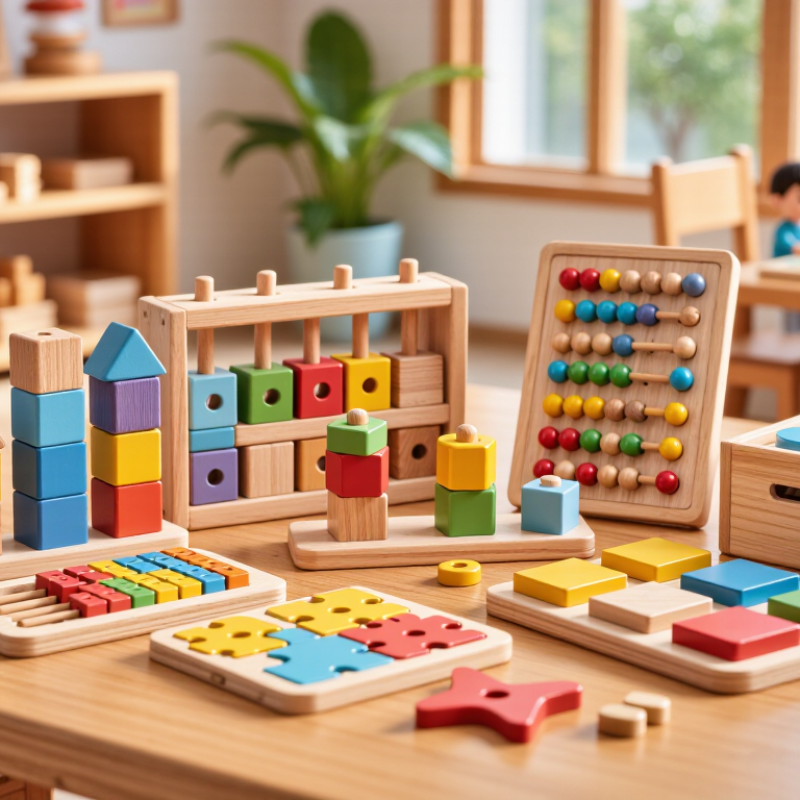
A sustainable wooden educational toy is made to support learning while reducing waste across its life cycle. It uses wood from responsibly managed sources, but wood alone does not make a toy sustainable. The design should be durable, repairable, and useful beyond a brief trend. That distinction matters.
Core features include sturdy construction, smooth edges, and finishes suited to children’s play. A wooden sorting board, for example, should withstand repeated handling without loose pieces or splintering. Clear shapes and simple colors can help children practice matching, counting, and coordination. The learning goal should be easy to recognize, not hidden beneath decorative details. Safety and quality still need careful checks.
Sustainability also depends on what happens after purchase. Replaceable parts, minimal packaging, and designs that can be passed between children help extend a toy’s useful life. In a playroom, a block set that stays complete and inviting is more valuable than one that looks natural but breaks quickly. There are trade-offs. A durable toy may use more material, and a natural finish is not automatically safer or lower-impact. Claims should be specific and verifiable. That part deserves scrutiny.
China’s wooden educational toys often begin with renewable wood from managed plantations. Common sources include poplar, pine, and rubberwood. These trees can support repeated harvesting when forests are carefully planned. However, replanting alone does not guarantee sustainability.
Responsible forestry protects soil, water, and local wildlife during harvesting. Good forestry teams map planting areas, limit clear-cutting, and maintain vegetation beside streams. Mixed-age trees can also reduce erosion and improve habitat. Small details matter.
From a sourcing perspective, manufacturers should request harvest permits, origin records, and chain-of-custody documents. Independent audits can verify whether suppliers follow approved forestry plans. Factory teams may also check wood moisture, storage conditions, and species records. Traceability should reach the forest, not stop at the warehouse.
The system is not perfect. A newly planted sapling cannot replace a mature forest immediately. Plantation forests may also support fewer species than natural woodland. Better practice means admitting these limits and improving them through mixed planting, longer growing cycles, and community oversight. For educational toys, responsible wood sourcing connects classroom learning with real environmental choices.
China Top 10 What Makes Wooden Educational Toys Sustainable?
Wooden educational toys support sustainability when their materials protect both forests and children. Look for responsibly sourced wood with clear documentation. Solid wood usually lasts longer than thin composite boards. However, “natural” does not automatically mean harmless. Some wood treatments may still release irritating substances indoors. Ask suppliers for independent testing reports covering heavy metals, formaldehyde, and other restricted chemicals.
Safe finishes matter because children often touch, scratch, and mouth toy surfaces. Water-based coatings can reduce strong odors, but the label alone proves little. A reliable product should have a smooth finish, sealed edges, and no peeling paint. Check for splinters around handles, puzzle cuts, and drilled holes. Small loose parts also require careful age guidance. Child health depends on design, hygiene, and supervision, not materials alone. I sometimes find attractive toys with excellent wood but weak finishing. That contradiction deserves attention.
Tips: Rub the surface with a clean cloth. Watch for color transfer or rough fibers. Smell the toy after opening the package. A sharp chemical odor is a warning sign, not a quality feature. Choose toys with test records, traceable material details, and readable care instructions. Clean them with a damp cloth instead of harsh chemicals. Recheck older toys regularly, because cracks can collect dirt and expose unfinished wood.
| No. | Sustainability and safety factor | What to look for | Why it matters for children and the environment |
|---|---|---|---|
| 1 | Traceable wood sourcing | Ask for the wood species and sourcing information. Where forest certification is claimed, check that the claim applies to the material in the product and can be verified. | Responsible forestry can help reduce pressure on forests. Certification or a “natural wood” description alone does not establish toy safety. |
| 2 | Suitable wood and board materials | Look for clearly identified wood materials and information about any plywood, composite board, or bonded components. Request relevant chemical-emissions test information when applicable. | Wood products and their binders can differ in composition. Material disclosure and appropriate testing provide more useful evidence than appearance alone. |
| 3 | Tested surface coatings | Request test documentation for paints, stains, inks, and other coatings against applicable toy-safety chemical requirements. “Water-based” or “natural” should not be treated as proof of safety by itself. | Children may touch toys frequently and sometimes mouth them. Testing helps assess restricted substances and coating-related exposure risks. |
| 4 | Appropriate adhesives | For glued parts or laminated materials, ask what adhesive system is used and whether the finished toy has been assessed for relevant chemical requirements. | Adhesives are part of the finished product and should be considered alongside the wood and surface finish, particularly where children may chew or handle the toy. |
| 5 | Smooth edges and secure parts | Check for splinters, sharp points, cracks, loose fittings, and parts that could detach. Select toys designed for the child’s age and stage of development. | Good workmanship reduces risks from cuts, breakage, and small parts. Age grading and mechanical-safety checks are important, especially for younger children. |
| 6 | Compliance and independent testing | For toys sold in China, request applicable conformity and test information for the current GB 6675 toy-safety standards. Check that reports identify the tested product and relevant test scope. | A specific, traceable report is more informative than a general safety claim. Requirements can depend on the toy, its intended age group, and the market. |
| 7 | Durable construction | Look for sturdy joints, resilient components, and a design that can withstand ordinary age-appropriate play. Follow care instructions and inspect toys for damage over time. | A toy that remains usable longer may need replacing less often. Durability does not remove the need to check for wear, splinters, or loose pieces. |
| 8 | Repairability and replaceable parts | Prefer designs with accessible, repairable connections and ask whether safe replacement parts or repair guidance are available. | Repair can extend product life and reduce waste. Repairs should preserve the toy’s structural and chemical safety. |
| 9 | Efficient packaging | Check whether packaging avoids unnecessary layers and uses materials that can be separated for local recycling. Recycling options vary by location. | Reducing excess packaging can lower material use and household waste, while clear material information makes disposal easier. |
| 10 | Transparent product information | Look for clear age guidance, care instructions, material details, warnings where relevant, and a way to identify the product and its responsible supplier. | Useful information helps caregivers choose an appropriate toy, use it as intended, and respond to damage or product-safety concerns. |
Note: Sustainability and safety are separate considerations. Evaluate the finished toy using current, product-specific documentation; material labels alone cannot confirm that a toy is safe or environmentally preferable.
China Top 10 What Makes Wooden Educational Toys Sustainable?
Durable Design, Repairability, and Long-Term Educational Value
A sustainable wooden educational toy should survive more than one enthusiastic child. Thick beech or rubberwood pieces, rounded edges, and firmly joined parts resist daily drops and repeated handling. I look for smooth surfaces, tight connections, and finishes that do not flake during ordinary play. Durability is practical, not decorative. A puzzle that still fits after five years creates less waste and keeps its learning purpose alive.
Repairability matters just as much. Replaceable cords, simple screws, and detachable wheels can extend a toy’s working life. Families should be able to tighten a loose axle or sand a small rough spot safely, rather than discard the whole item. Clear care instructions and accessible replacement parts also show responsible manufacturing. Still, wooden toys are not automatically sustainable. Poorly dried timber may warp, while complex glued assemblies can become difficult to repair. That weakness deserves honest attention.
Long-term educational value gives the material a second life. Counting boards can support early mathematics, then become tools for patterns, sorting, or storytelling. Open-ended blocks encourage children to rebuild instead of follow a fixed sequence. Teachers can observe progress through changing constructions, not just correct answers. A durable toy may look simple, yet its value depends on thoughtful use, safe materials, and patient adult guidance. Some designs will fail. That is useful feedback for better future products.
Durable design, repairability, and long-term educational value
The chart uses a 0–100 relative sustainability index based on practical product-design criteria: expected service life, ease of repair, use of renewable wood, material simplicity, safety, and the ability to support learning across different ages. Durable construction and open-ended educational use help keep wooden toys in circulation longer, reducing the need for frequent replacement.
Efficient manufacturing can make wooden educational toys more sustainable before they reach a child’s hands. Careful cutting plans help factories use more of each board and send less clean wood to the scrap bin. Offcuts can sometimes become small puzzle pieces or test samples. Less scrap matters. Shops can also track energy use, defect rates, and material sources instead of relying on broad environmental claims. Still, a fast production line is not automatically a responsible one; durability and safe finishing need attention too.
Packaging is another practical place to reduce waste. A toy with a few sturdy parts may need only a close-fitting recycled-cardboard box, a paper instruction sheet, and simple protective inserts. Avoiding oversized boxes cuts storage and shipping volume. Minimal should not mean fragile, though. A cracked toy after one delivery creates waste of its own. Packaging trials can reveal whether a smaller design protects corners and painted surfaces during ordinary handling.
End-of-life choices are less simple. Solid, untreated wood may be repairable, reusable, or accepted by local wood-recycling programs, but coatings, adhesives, and mixed materials can limit those options. Clear material information helps families and educators decide what to do. Manufacturers should check local recycling guidance rather than promise that every toy is recyclable everywhere. Even a well-made toy may eventually break. Replaceable parts and repair instructions can keep it useful longer.
Poplar, pine, and rubberwood can come from managed plantations. The wood’s origin still needs careful checking.
No. Young saplings cannot immediately replace mature woodland, and plantations may support fewer wildlife species.
Forestry teams can limit clear-cutting, protect streamside plants, and mix trees of different ages. Small details matter.
They can request origin records and chain-of-custody documents. Independent audits can check whether suppliers follow forestry plans.
Thick wood, rounded edges, and firm joints can handle drops and repeated play. A puzzle should still fit years later.
Replaceable cords, simple screws, and detachable wheels make repairs easier. A loose axle may only need tightening.
No. Poorly dried timber may warp, while heavy glue can make repairs difficult. Wood alone is not enough.
A counting board can later help children sort shapes or make patterns. Open-ended blocks invite new builds, though some designs will fail.
What makes wooden educational toys sustainable is the combination of responsible materials, safe production, long-lasting design, and thoughtful end-of-life planning. In China, sustainably produced toys can begin with renewable wood sourced through responsible forestry practices that protect ecosystems and support continued forest growth. Non-toxic paints, water-based finishes, and child-safe adhesives also help reduce health risks while creating a safer play experience. Clear quality controls are essential to ensure that every component is suitable for children.
Sustainability also depends on durability and educational value. Strong construction allows toys to withstand repeated use, while repairable parts can extend their lifespan and reduce waste. Efficient manufacturing can lower material and energy consumption, and minimal packaging helps avoid unnecessary resources. When a toy eventually reaches the end of its useful life, recyclable or biodegradable components make disposal more responsible. Together, these features create educational products that support children’s development while reducing environmental impact throughout their lifecycle.

Chicharo Toys