In 2026, wooden toys remain valuable tools for active, hands-on classroom learning. Their simple forms invite children to touch, build, sort, compare, and revise ideas. A wooden block can become a bridge, a number line, or a small city. The learning changes with every child’s plan.
So, how can wooden toys support classroom learning? They connect abstract concepts with visible actions. Counting bears support one-to-one correspondence. Pattern tiles introduce symmetry and early geometry. Wooden letters strengthen sound recognition through movement and repetition. Puzzles encourage spatial reasoning, patience, and problem-solving. Open-ended sets also support language development, because children explain what they built and why.
American psychiatrist and play researcher Dr. Stuart Brown writes, “The opposite of play is not work—the opposite of play is depression.” His observation supports a classroom where purposeful play is treated as serious learning, not wasted time. Teachers can use wooden toys during guided activities, small-group stations, or quiet choice periods. A child may quietly balance five blocks, notice one falls, and try again. That small failure has instructional value.
Still, wooden toys are not automatically educational. Their impact depends on thoughtful selection, clear learning goals, supervision, and inclusive access. Some classrooms may need larger pieces, sensory alternatives, or visual instructions. Evidence is also uneven across toy types, so confident claims should be avoided. The best choices are durable, safe, age-appropriate, and connected to real classroom observations. This guide explores the top types of wooden toys for classroom learning in 2026, while recognizing that teachers remain the most important learning resource.
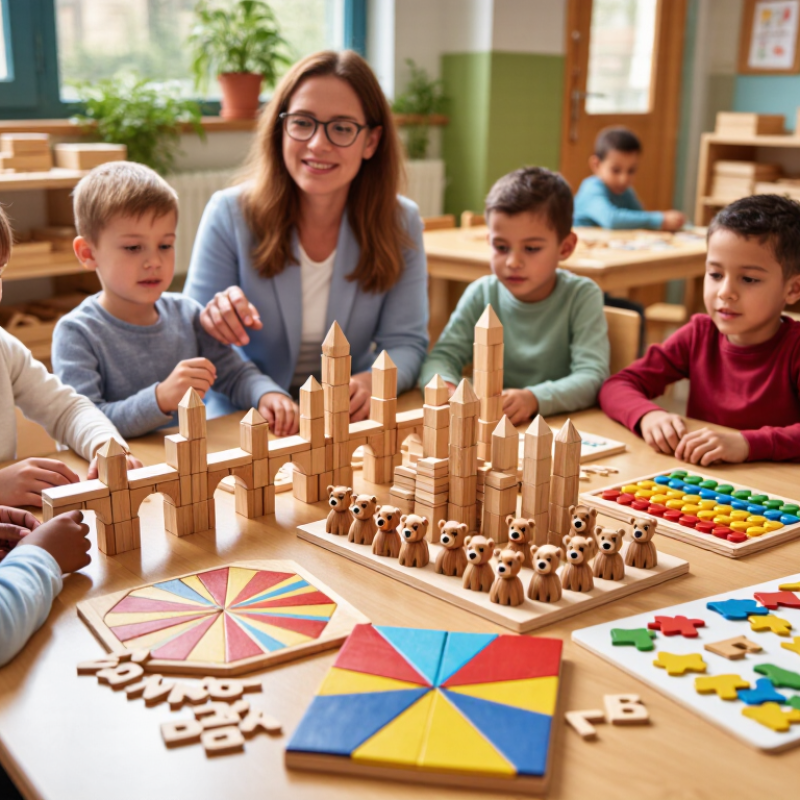
Wooden toys are learning tools made mainly from wood, designed for children to handle, explore, and use in purposeful play. In a classroom, they may include sorting boards, blocks, puzzles, counting pieces, and pretend-play objects. Their simple shapes invite children to test ideas rather than follow one fixed script. A child might stack three blocks, watch them fall, and adjust the base. Small discoveries matter.
These toys support learning through touch, movement, and conversation. Children can compare sizes, group objects by color, practice counting, or build structures together. A teacher may use wooden counters to make addition visible, then ask students to explain how they reached an answer. This encourages language, reasoning, and cooperation alongside early math skills. The material itself does not guarantee learning; thoughtful adult guidance and a suitable challenge make the difference.
Wood can feel warm and substantial in a child’s hands, which may help sustain hands-on attention. Yet wooden pieces can be heavy, and some activities may frustrate children who need more flexible or sensory-rich options. That is worth considering. Educators should choose age-appropriate toys with smooth surfaces, secure construction, and pieces large enough for the intended group. They should also inspect toys regularly for splinters or damage. Used with care, wooden toys offer an open-ended way to connect classroom concepts with actions children can see and repeat.
| Type of Wooden Toy | Definition | Role in Classroom Learning | Example Learning Activity | Typical Use |
|---|---|---|---|---|
| Building blocks | Solid wooden pieces in shapes such as cubes, rectangles, and arches, used for stacking and construction. | Encourage spatial reasoning, early engineering thinking, planning, and cooperative problem-solving. | Build a bridge that can support a small classroom object, then compare different designs. | Preschool and early elementary construction centers. |
| Wooden puzzles | Boards or sets of interlocking wooden pieces that form a picture, pattern, or shape when correctly arranged. | Provide practice with visual discrimination, shape recognition, fine-motor coordination, and persistence. | Sort pieces by color or shape before assembling a picture puzzle. | Independent work, small-group tasks, or learning centers. |
| Counting and sorting manipulatives | Small wooden counters, shapes, or objects used to represent quantities and categories. | Make early math concepts tangible, including counting, comparing quantities, classifying, and creating patterns. | Group counters by shape, make a repeating pattern, or use them to model a simple addition problem. | Math centers; select piece size appropriate to learners’ age. |
| Shape sorters and nesting toys | Containers or boards with matching openings, or graduated pieces that fit inside or stack with one another. | Support shape matching, comparison, spatial awareness, and trial-and-error reasoning. | Match each piece to an opening and describe how its shape or size helped determine the fit. | Early-years discovery and fine-motor activities. |
| Lacing and threading toys | Large wooden beads or perforated pieces designed to be threaded with a cord or lace. | Develop hand-eye coordination, bilateral hand use, sequencing, and pattern-making. | Thread pieces in a repeating color or shape sequence and explain the pattern. | Fine-motor stations with age-appropriate pieces and supervision. |
| Pretend-play sets | Wooden play objects representing familiar items, such as food, vehicles, or household tools. | Invite imaginative role-play and provide opportunities to practice language, turn-taking, and social interaction. | Set up a pretend shop where learners take turns being the customer and shopkeeper. | Dramatic-play areas and guided language activities. |
| Wooden musical instruments | Simple sound-making objects, such as rhythm sticks or small percussion instruments made with wooden parts. | Support listening, steady-beat practice, sound comparison, and group participation in music activities. | Copy a short rhythm and take turns leading a group pattern. | Music and movement sessions; use with clear handling rules. |
| Wooden letter and number pieces | Raised or loose wooden forms representing letters, numerals, or simple symbols. | Offer a hands-on way to recognize symbols, sequence letters or numbers, and connect print or numerals with classroom activities. | Arrange number pieces in order or match a letter piece to a picture beginning with that sound. | Early literacy and numeracy centers. |
| Classroom note: Wooden toys are play and learning materials, not a guarantee of a particular learning outcome. Choose pieces suited to learners’ ages and abilities, inspect them regularly for damage or splinters, and follow applicable toy-safety guidance. Small parts may pose a choking risk for young children. | ||||
Blocks support spatial reasoning, balance, measurement, and planning. Children may build a bridge, test it, and change the design. The tower still falls.
Puzzles strengthen visual discrimination, fine-motor control, and flexible thinking. Children rotate pieces, compare shapes, and adjust their grip. Some puzzles become repetitive.
Children can count beads, sort shapes, and compare tower heights. They can also create repeating patterns with colored blocks. Small pieces vanish easily.
Children can change a ramp’s height and observe how far a wooden vehicle travels. They may record results with drawings or tally marks. The setup is modest.
Picture blocks and small figures can prompt storytelling and sequencing. Children might arrange three figures to show what happened before, during, and after. New words emerge naturally.
Role-play encourages negotiation, vocabulary, and emotional expression. Children can explore community roles through simple scenes and shared conversations. Not every child joins quickly.
Match each toy with a clear learning goal. Offer picture cards beside blocks when children need prompts. Change the question for different ages.
Watch children’s grip, frustration, persistence, and peer talk. Ask, “What could make it stronger?” Avoid correcting every mistake. Productive struggle matters.
Not always. Children may focus on building the tallest tower instead of explaining their choices. Teacher questions can turn play into deeper learning. I may overestimate the toy itself.
Check smooth surfaces, secure parts, and age-appropriate sizes. Store small pieces carefully after counting activities. Safety needs repeated attention.
Wooden toys play an important role in classroom learning by turning abstract ideas into hands-on experiences. This article explains how can wooden toys support classroom learning through their ability to encourage creativity, problem-solving, communication, fine motor skills, and independent thinking. It introduces major types, including building blocks, puzzles, counting sets, pattern boards, role-play materials, and sensory tools, while describing the educational purpose of each. It also offers guidance on choosing suitable toys for early childhood, preschool, and primary learning stages, considering children’s abilities, interests, and developmental needs.
In addition, the article explores classroom applications across mathematics, language, science, art, social development, and practical life skills. Teachers can use wooden toys for individual practice, small-group activities, guided lessons, and imaginative projects. Finally, it highlights essential standards for safety, sustainability, and care, such as smooth surfaces, non-toxic finishes, durable construction, responsible materials, regular inspection, proper cleaning, and organized storage.

 Chicharo Toys
