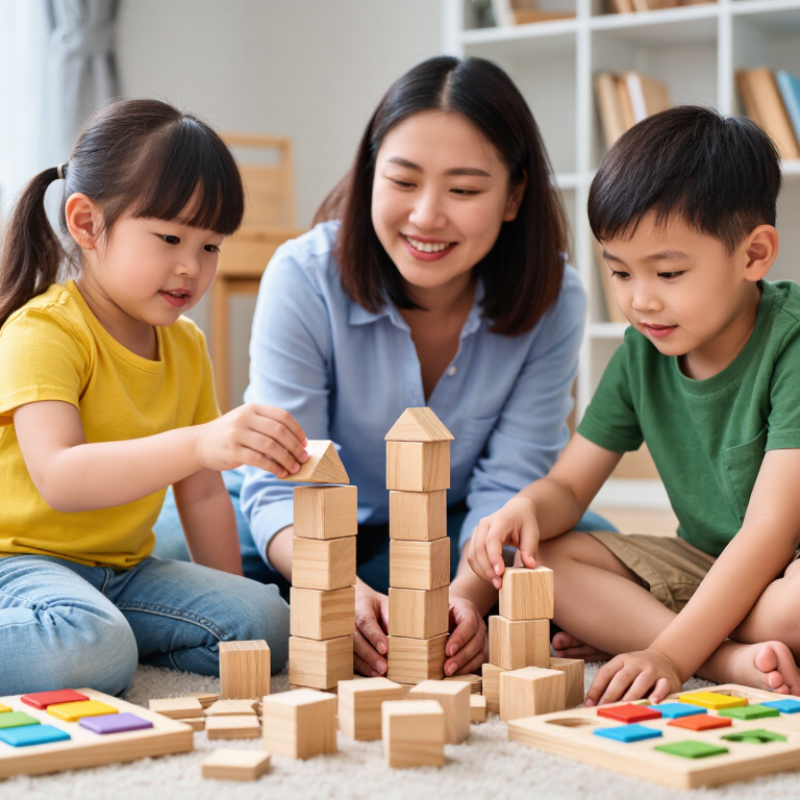
A wooden block tower wobbles, tips, and gets rebuilt. In moments like this, children test ideas, notice cause and effect, and practice persistence. The toy itself does not teach every skill; the child’s actions and the adult’s support matter, too. So, how do wooden educational toys support child development? They can create hands-on opportunities to explore, sort, stack, match, and imagine. A smooth puzzle piece may invite a child to turn it until it fits. A set of differently sized blocks can prompt comparisons of height, balance, and shape.
These experiences may support fine motor coordination, spatial reasoning, early problem-solving, and language when children describe what they are doing. Shared play can also encourage turn-taking and cooperation. Small moments matter. A caregiver asking, “What could make it steadier?” may extend a child’s thinking without taking over. Still, wooden toys are not automatically better, safer, or more educational than other well-designed toys. Their value depends on factors such as age suitability, construction, play possibilities, and the child’s interest. Check for sturdy parts, smooth finishes, and clear age guidance, and supervise play when needed. A child may ignore an expensive wooden set and prefer a cardboard box. That matters. This guide explores the developmental benefits these toys may offer, what evidence and practical experience can reasonably support, and how to choose toys that invite meaningful play without promising instant results.
What Defines a Wooden Educational Toy?
A wooden educational toy is more than an object made from timber. It uses hands-on play to invite a child to practise a skill, explore an idea, or solve a small problem. A set of blocks can support spatial reasoning when a child balances a short tower; a shape sorter can encourage matching and persistence. The American Academy of Pediatrics’ 2018 clinical report, “The Power of Play,” describes play as supporting children’s cognitive, physical, social, and emotional development. Wood alone does not make a toy educational. Its purpose, age suitability, smooth edges, and manageable pieces matter too.
Tips: Look for pieces a child can grasp and use in more than one way. Check for splinters, loose parts, and finishes that may wear over time. Offer a simple prompt, such as, “Can you make a bridge?” Then let the child experiment.
The World Health Organization’s 2019 guidelines recommend at least 180 minutes of varied physical activity each day for children aged one to four. Building, sorting, and reaching for pieces can add movement to play, though a toy cannot replace active play overall. Some wooden toys feel heavy or frustrating to younger children; that is worth noticing, not dismissing. A quieter, simpler design may invite more exploration than one with many rules.
How Wooden Toys Develop Sensory and Motor Skills
A wooden shape sorter gives a child more than a puzzle to solve. A block’s weight, smooth edge, and faint tap against the floor offer distinct sensory feedback. Gripping, turning, and fitting pieces also asks small hands to adjust pressure and direction. An adult can notice these efforts in real time: a child may rotate a triangle repeatedly before it fits. That repetition matters, even when the “right” answer takes a while.
The CDC’s developmental milestones list trying switches, knobs, or buttons among skills many children show by age two. Large wooden knobs and simple latches can invite similar hand movements, though a toy cannot guarantee a milestone. For children aged three to four, the WHO’s 2019 physical activity guidelines recommend at least 180 minutes of activity daily, including 60 minutes of moderate-to-vigorous activity. Toy play is only one small part of that total. It may also be messy: pieces slide, towers topple, and some children lose interest quickly. Wooden toys are not automatically better for development than other safe toys; the child’s chance to explore, repeat, and move is what counts.
How Wooden Toys Can Support Sensory and Motor Skill Development
Toy-based activities can give children opportunities to grasp, reach, explore, and manipulate objects. These CDC milestones show typical ages by which most children (at least 75%) can perform the listed hand-related skills; they do not measure the effect of any particular toy.
How to read the chart: The bars mark the milestone ages in months, not a recommended age for a specific toy. Age-appropriate wooden blocks, cups, and graspable toys can provide chances to practise these actions through play. Choose toys that are safe for the child’s age and supervise play.
Source: CDC developmental milestones.
How Hands-On Play Builds Thinking and Problem-Solving
Wooden toys can turn an idea into something a child can hold, move, and test. A set of blocks may become a bridge, then collapse when the middle piece shifts. That matters. A child can notice weight, balance, and cause and effect through repeated attempts, rather than hearing those ideas explained. A wooden shape sorter invites another kind of thinking: turning a piece, comparing edges, and changing direction when it does not fit. There is no single answer.
These small challenges can support planning and flexible problem-solving. A child might sort pieces by size, build a taller tower, or work out why a puzzle corner will not settle. Adults can ask, “What could you try?” and leave room for the child to decide. Too much help can remove the useful struggle; too little may turn play into frustration. The balance varies with age, mood, and the task. It can be tempting to praise only a finished tower, but noticing the process can be more helpful: “You moved the wide block to the bottom.” Still, wooden toys are not automatically educational. A simple object works best when it invites exploration and an attentive adult is nearby, without directing every move.
How Do Wooden Educational Toys Support Child Development? - How Hands-On Play Builds Thinking and Problem-Solving
| Development area |
How hands-on play can help |
Skills children may practise |
Example play activity |
| Thinking and problem-solving |
Building, sorting, and fitting pieces gives children opportunities to test ideas, notice results, and try a different approach when something does not work. |
Planning, comparing, pattern recognition, cause and effect, and flexible thinking. |
Use blocks to make a bridge that can support a small toy; adjust the design if it falls. |
| Fine-motor coordination |
Picking up, turning, stacking, and connecting pieces gives children practice coordinating small hand movements with what they see. |
Hand–eye coordination, grasp control, and precision. |
Thread large wooden beads onto a lace or place chunky puzzle pieces into matching spaces. |
| Spatial reasoning and early maths |
Moving objects and building structures lets children explore how shapes, sizes, positions, and quantities relate to one another. |
Shape and size comparison, counting, sequencing, balance, and spatial vocabulary. |
Sort blocks by shape or size, then build a tower and compare its height with another tower. |
| Language and communication |
Talking about a shared activity gives adults and children natural chances to describe actions, ask questions, and explain ideas. |
Vocabulary, listening, turn-taking, and explaining a plan. |
Invite a child to describe how they sorted pieces or explain what they are building. |
| Creativity and imaginative play |
Simple, open-ended pieces can be used in different ways, allowing children to invent structures, stories, or pretend-play settings. |
Idea generation, symbolic thinking, storytelling, and creative experimentation. |
Turn blocks into a pretend shop, animal shelter, or landscape and make up a story together. |
| Persistence and self-regulation |
A manageable challenge can encourage children to pause, repeat an attempt, and cope with small setbacks during play. |
Patience, attention, frustration tolerance, and independent effort. |
Work through a puzzle at the child’s pace, offering encouragement without immediately providing the solution. |
Note: These opportunities come mainly from active, age-appropriate play and interaction—not from wood itself. Choose toys suited to the child’s age and abilities, and supervise play where small parts may pose a choking risk.
How Shared Play Supports Language and Social Growth
When children share wooden blocks, animals, or simple puzzles, play becomes a reason to talk. A child might ask, “Can I have the red one?” or explain where a wooden bridge should go. These small exchanges give children practice naming objects, asking questions, and listening to another person’s ideas. The toy itself does not teach language; the conversation around it creates opportunities to use words.
Shared play also helps children notice social cues. A pause can mean a friend is waiting for a turn. A changed plan may require negotiation: “Let’s make the tower wider.” Adults can support this by joining briefly, describing what they see, and leaving space for children to respond. Open-ended wooden toys are useful because they can become many things, so children have room to shape a shared story together.
Not every moment feels cooperative. A child may grab a piece or reject a friend’s idea. That is part of the learning, though it can be uncomfortable to watch. Instead of settling every disagreement immediately, an adult can calmly suggest words such as, “I was using that,” or “Can we take turns?” Children develop at different speeds, and some will need more guidance than others. The goal is not perfect play. It is a safe chance to practice speaking, listening, and repairing small misunderstandings.
Why Age-Appropriate Design Matters for Learning and Safety
Wooden educational toys support learning best when their challenge fits a child’s age, coordination, and interests. Toddlers can grasp large blocks and sort simple shapes; older preschoolers may build patterns or balance a small tower. The right level encourages practice without turning play into a test. Small parts matter. Check for loose pieces, splinters, sharp edges, and damaged finishes. The U.S. Consumer Product Safety Commission estimated 209,500 toy-related injuries were treated in emergency departments in 2022. Age labels help guide selection, but they cannot account for every child or every play situation. Some age bands can feel blunt.
Tips: Follow the age guidance, inspect toys regularly, and supervise young children, especially around small components. Offer a task the child can nearly manage, then leave room for their own approach.
The American Academy of Pediatrics’ 2018 clinical report, “The Power of Play,” describes play as supporting language, social skills, and executive function. Open-ended wooden toys can invite children to test ideas, notice why a tower tips, and try again. A flawless result is not the point. Adults can support learning by naming a child’s choices without taking over. Still, a toy alone does not teach; interaction, time, and a safe space matter too.
Conclusion
How do wooden educational toys support child development? They give children hands-on ways to explore shapes, textures, sounds, and movement, helping strengthen sensory awareness and fine motor skills. As children stack blocks, fit pieces together, or move objects, they practise coordination and learn through trial and error. These activities also encourage thinking: children can plan, notice patterns, test ideas, and find solutions when something does not work as expected.
Playing with others adds opportunities to practise language, listening, turn-taking, and cooperation. The simplicity of many wooden toys leaves room for imagination, allowing children to invent their own ways to play. Age-appropriate design matters too: toys should suit a child’s abilities, offer manageable challenges, and be made with safe, durable features. Together, thoughtful design and open-ended play can support learning at different stages of childhood.

 Chicharo Toys
